Resilience and Resolve: Afghanistan's Path towards Trachoma Elimination
March 18, 2026
Since its inception, partnership has been at the heart of Afghanistan’s trachoma program, enabling it to navigate complex challenges and ensure that even the most remote and hard-to-reach communities have access to the interventions needed to eliminate trachoma as a public health problem.
Beginning in 2006, HealthNet TPO and the Fred Hollows Foundation (FHF) have worked with Afghanistan’s Ministry of Public Health (MoPH) to expand comprehensive eye care services. In 2018, the National Committee for Eye Health, with partner support, began conducting baseline surveys using the Tropical Data platform, which covered 72 districts across 16 provinces. Of the 72 districts surveyed, eight districts in Kunar and Samangan provinces were found to warrant intervention.
Momentum continued to build. Following the development of a Trachoma Action Plan in 2023 that aligned stakeholders around a clear roadmap, FHF secured funding to launch mass drug administration (MDA) in the eight known-endemic districts of Afghanistan in Kunar and Samangan provinces for 2025. In an incredible demonstration of cross-country collaboration, Uganda’s trachoma program hosted leaders from Afghanistan in May 2025 for a Training of Trainers, equipping them with the knowledge and field experience needed to deliver high-quality mass drug administration.
The program’s resilience and momentum was tested when a devastating earthquake struck Kunar province in August 2025, a few months before MDAs were set to begin, damaging infrastructure and displacing families. Yet even amid disruption, partners adapted quickly to first help their communities respond to this disaster and then adjust plans to keep trachoma elimination efforts on track. Thanks to the strong partnership between ITI, the MoPH, HealthNet TPO, and FHF, by October 2025, more than 450,000 doses of donated azithromycin arrived in Afghanistan; ensuring treatment could move forward and reach the communities who needed it most.
By January 2026, seven of the eight known-endemic districts had successfully completed MDA, with the final district expected to complete its round in April.
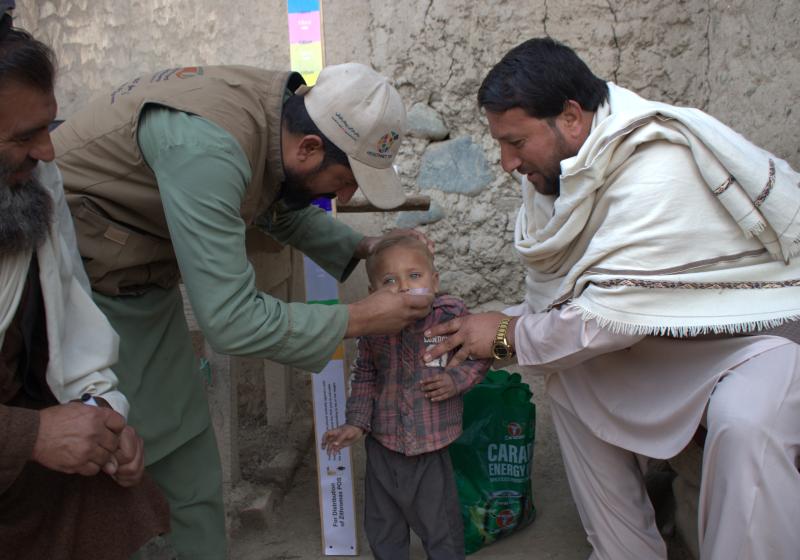
With azithromycin generously donated by Pfizer and delivered through ITI, and support from FHF and END Fund, the MoPH and HealthNet TPO mobilized communities using culturally tailored health education campaigns, engagement with religious leaders and teachers, and widespread media outreach to raise awareness and encourage participation.
Distribution strategies were designed to ensure no one was left behind. Teams implemented both school-based and house-to-house delivery, which was an essential approach in Afghanistan to reach women and girls who may otherwise face barriers to access. Leveraging the country’s established Community Health Worker network (40% of whom are women), the program delivered treatment directly to households, ensuring broad and equitable coverage.
This achievement reflects the power of sustained partnership and shared commitment. Pfizer’s donation of azithromycin channeled through ITI has been central to enabling Afghanistan to take this critical step toward eliminating trachoma as a public health problem. Together, government leaders, health workers, communities, and global partners are proving that even in the most challenging contexts, progress is possible.